
Strategy Isn’t a Deck — It’s a Decision System
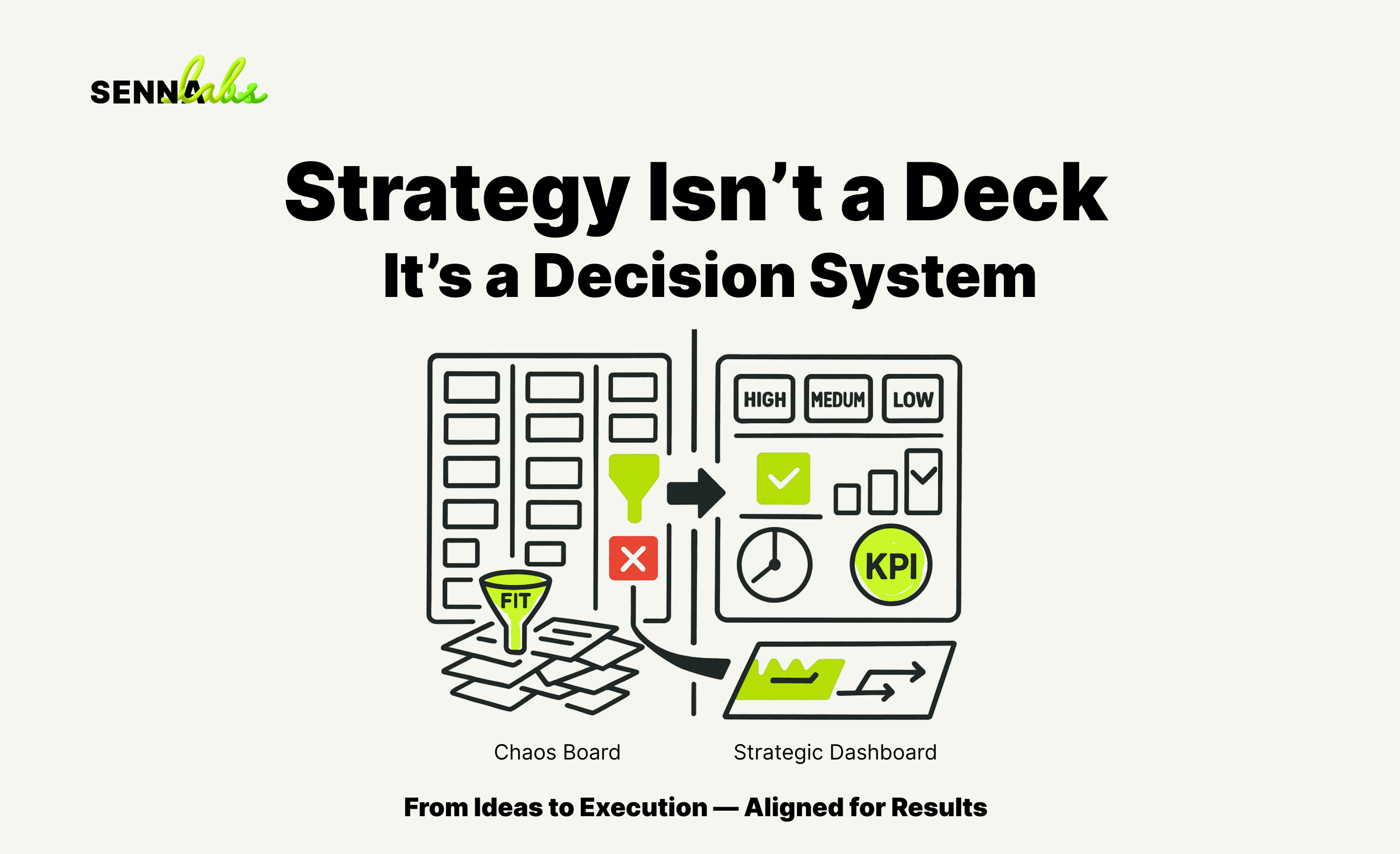
Strategy often starts with bold ideas. A vision. A direction.
But somewhere between the slide deck and the daily standup, it gets lost.
Founders say they want focus — but chase every shiny opportunity.
Teams try to execute — but aren’t sure what matters most.
And systems? They track everything… except strategic alignment.
The problem isn’t the strategy itself.
The problem is that strategy lives on slides — not in the decisions your business makes every day.

Strategy is How You Decide — Not What You Say
We like to think of strategy as something inspirational.
A big-picture vision. A north star.
And that’s part of it. But real strategy shows up in what gets done — and what doesn’t.
It’s how your team answers questions like:
-
Should we take on this client?
-
Should we build this feature?
-
Should we pursue this channel?
If you don’t have a clear, consistent way to filter and focus, then your team will default to instinct, opinion, or urgency — and you’ll drift.
That’s not lack of discipline. It’s lack of design.
What a Decision System Looks Like (In Practice)
At Senna Labs, we work with growing businesses that are often saying yes to too many things.
When everything looks like a good idea, your team ends up:
-
Spread thin
-
Building the wrong things
-
Confused about direction
-
Reacting instead of executing
That’s when we help them build a decision system — something that embeds strategy into operations.
Here’s how it works:
Step 1: Define Your Strategic Filter
Every team needs a shared lens for decision-making. A good filter includes:
-
What game you’re playing:
Are you optimizing for growth, profitability, speed, or quality? -
What you’re not doing:
What markets, features, or client types are off-focus? -
How you measure impact:
What makes a project or initiative “worth it”?
We often codify this in a Strategic Clarity Framework — a one-page reference that helps teams prioritize with confidence.
Step 2: Make Strategy Visible in the Tools You Use
A deck is static.
But tools like dashboards, boards, and roadmaps are dynamic.
We help teams embed their strategic filters into the software they already use:
-
A product roadmap that scores every feature against strategic criteria
-
A sales pipeline view that flags high-fit vs low-fit leads
-
A project board that sorts by strategic priority, not just due date
Now strategy isn’t something you revisit once a quarter — it’s something you see every day.
Step 3: Review What You’re Saying Yes To
Each week, we help clients run a short, simple check-in:
“What did we say yes to this week — and did it match our strategy?”
This doesn’t require a workshop.
Just a system that tracks decisions against focus.
If something keeps falling outside the lens, it’s a flag — not a failure.
Strategy Without Systems Is Just Hope
It’s not enough to know your strategy.
You need to see it — feel it — and use it as a filter for everything you do.
That’s what a decision system is:
-
It’s simple
-
It’s visible
-
It’s embedded into your tools
-
And it helps your team act with clarity, not chaos
Start Here: The Strategic Clarity Framework
If your team feels pulled in too many directions, don’t jump into another strategy session. Use the Strategic Clarity Framework — a one-page tool to help your team define its decision filter and make strategy real again.


Subscribe to follow product news, latest in technology, solutions, and updates
Other articles for you



Let’s build digital products that are simply awesome !
We will get back to you within 24 hours!Go to contact us Please tell us your ideas.







 28/11 Soi Ruamrudee, Lumphini, Pathumwan, Bangkok 10330+66 62 389 4599hello@sennalabs.com© 2022 Senna Labs Co., Ltd.All rights reserved.